 blog
ATV Financing Options Near Me: A 2026 Guide
Table of Contents
- Finding ATV Financing Options Near Me: What Local Buyers Should Know
- Dealer Financing vs. Local Lenders: A Side-by-Side Comparison
- ATV Loan Requirements: What Lenders Actually Ask For
- How to Use an ATV Financing Calculator Before You Commit
- ATV Financing Rates: What Drives Your Interest Rate
- ATV Financing with Bad Credit: Realistic Paths Forward
- Pre-Qualification, Down Payments, and Protecting Your Credit Score
- Frequently Asked Questions
Last Updated: October 21, 2026
Finding ATV Financing Options Near Me: What Local Buyers Should Know
Most buyers searching for ATV financing options near me assume the dealership is the only door worth knocking on. That assumption costs money.
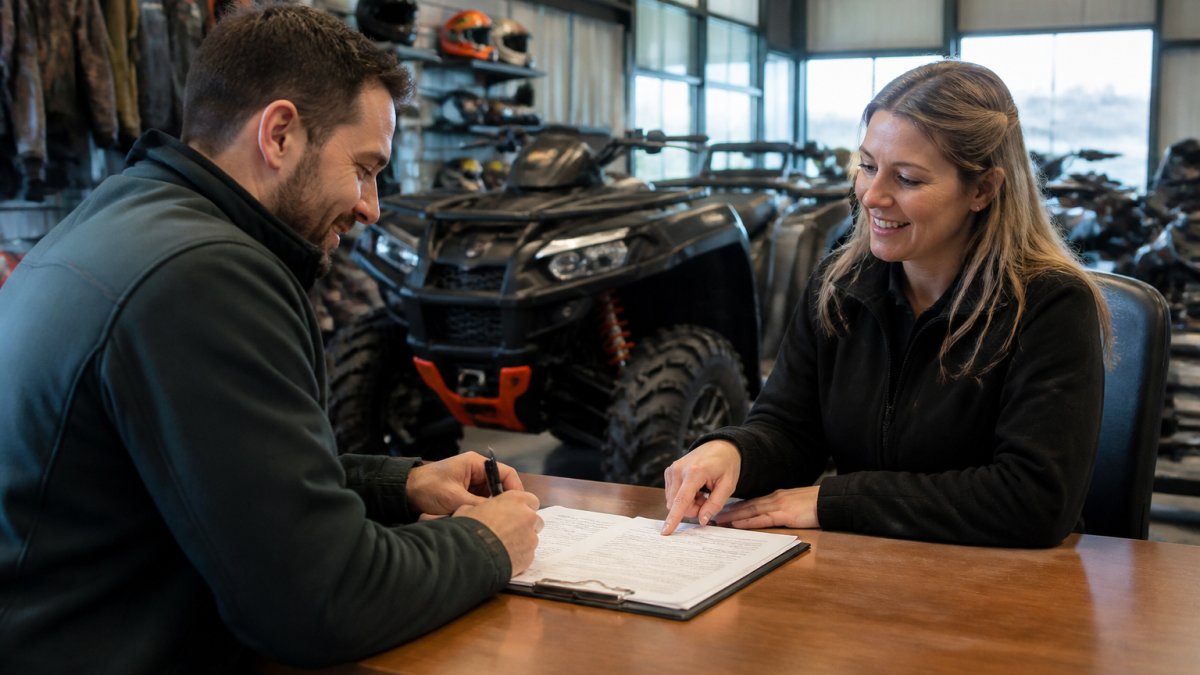
ATV financing is a loan or installment agreement that lets you spread the cost of an all-terrain vehicle over a set term instead of paying the full amount upfront.
Most guides treat financing as an afterthought. It isn't.
Dealer Financing vs. Local Lenders: A Side-by-Side Comparison
Dealer financing is arranged through the dealership at the point of sale; local lenders include banks and credit unions that issue the loan directly to you.
Dealership financing usually means one application, one conversation, and a same-day decision.
Banks and credit unions let you apply before you shop, giving you a firm budget. Credit unions are known for relationship-based lending, and a pre-arranged loan can simplify the process.
| Factor | Dealer Financing | Bank or Credit Union |
|---|---|---|
| Speed to decision | Often same day | Usually a few business days |
| Where you apply | At the dealership | Online, in branch, or by phone |
| Shopping flexibility | Tied to one dealership | Usable at any seller |
| Collateral familiarity | Strong, powersports-specific | Varies by lender |
| Best for | Buyers ready to purchase now | Buyers who want a set budget first |
Where Dealer Financing Wins
Speed and convenience are the real advantages. With a specific ATV in mind, dealer financing removes the guesswork of matching a loan to a machine, and a specialist can explain how powersports lenders view the vehicle as collateral, which matters for a side-by-side or UTV rather than a car.
Where Banks and Credit Unions Win
A pre-approved loan from your bank or credit union hands you negotiating power: you know your ceiling before you walk in and can compare the dealer's offer against a rate you already hold. An established local relationship can work in your favor.
ATV Loan Requirements: What Lenders Actually Ask For
ATV loan requirements generally come down to proof of identity, proof of income, and a credit check, though the exact list varies by lender. Having the core documents ready speeds up approval considerably.
Expect to provide government-issued photo ID, recent proof of income such as pay stubs or bank statements, your current address, and details of the vehicle.
If you are self-employed or have irregular income, be ready to show more documentation.
How to Use an ATV Financing Calculator Before You Commit
An ATV financing calculator estimates your monthly payment and total repayment from three inputs: amount financed, interest rate, and loan term. Running the numbers before you talk to a lender turns a vague hope into a real budget.
Here is a simple framework we suggest to buyers:
- Enter the purchase price, then subtract your down payment to get the amount financed
- Enter a realistic interest rate range, not just the best-case figure
- Test two or three loan terms and note how the monthly payment and total repayment change
- Add any fees the lender discloses so the comparison is apples to apples
- Confirm the monthly figure fits your budget with room to spare
Run the calculation twice with a slightly higher rate. If the higher payment still fits, you have a buffer against a rate above expectation. If not, adjust your down payment or choose a less expensive model.
ATV Financing Rates: What Drives Your Interest Rate
ATV financing rates depend on your credit score, loan term, down payment size, and vehicle age. New vehicles generally attract better terms than used ones, and shorter terms usually carry lower rates because the lender takes on less risk.
Your credit history is the biggest lever: a strong score earns a lower rate, while a thin or damaged file pushes it up. The down payment matters because it reduces the lender's risk if the vehicle is repossessed.
Compare APR, Not Just the Advertised Rate
The annual percentage rate (APR) folds the interest rate and most mandatory fees into one yearly number, making it the fairest single figure to compare across lenders. A low advertised rate with a hefty documentation fee can cost more than a slightly higher rate with no fees. Ask every lender for the APR in writing.
Build a Total Borrowing Cost Estimate
A monthly payment hides the full picture. Multiply the monthly payment by the number of payments, then add any down payment and upfront fees. That total outlay is the number to compare across two or three offers before you commit.
Here is a clearly labeled example calculation using round numbers for illustration only, not a quoted offer:
- Amount financed: $10,000
- Term: 48 months
- Illustrative APR: 8.99%
- Estimated monthly payment: roughly $249
- Total of payments over 48 months: roughly $11,952
- Total interest paid: roughly $1,952
Now change one variable. At the same amount and term but an illustrative APR of 12.99%, the monthly payment rises to roughly $269 and total interest climbs to roughly $2,912. Same machine, same term, about $960 more in interest.
Fees That Change the Math
Ask each lender to disclose in writing every fee: application, documentation or administration, lien registration, and any early repayment or prepayment penalty. A no-penalty prepayment clause lets you reduce total interest if you pay off early. If a lender won't put the full fee schedule in writing, treat that as a warning sign.
Term Length Trade-Off
A longer term lowers the monthly payment but raises total interest and increases the chance you owe more than the machine is worth partway through. The right balance is the shortest term whose payment still fits comfortably in your budget, not the longest the lender will approve.
Winter and Seasonal Cost Considerations
If you are financing an ATV for plowing or winter trail riding, budget for winter-ready accessories: a plow setup, winter tires or aggressive treads, and cold-weather gear. These costs are usually not part of the vehicle loan, so plan for them separately rather than stretching the term to cover them.
ATV Financing with Bad Credit: Realistic Paths Forward
ATV financing with bad credit is possible, but usually at a higher rate and with a larger down payment. Lenders price risk, and a damaged credit history signals more of it.
A larger down payment reduces the amount financed and can soften the rate. A creditworthy co-signer strengthens the application.
Be cautious with any lender that pressures you to sign quickly or won't put the full terms in writing. A legitimate financing arrangement is transparent about the rate, the term, the fees, and the total repayment before you commit.
Pre-Qualification, Down Payments, and Protecting Your Credit Score
Pre-qualification is an early estimate of what you might borrow, based on a soft credit check that does not affect your score. It lets you shop with a realistic budget before a formal application triggers a hard inquiry, which can cause a small, temporary dip.
Down payments and trade-ins both reduce the amount financed. An older ATV, UTV, or dirt bike can serve as a down payment and lower your monthly figure, estimate its value before you visit.
How to Find and Verify Genuinely Local Options
The 'near me' part of the search is where most guides stop being useful. Here is a practical method for finding lenders that actually serve your area and verifying them before you share sensitive information.
- Start with institutions you already use. Your current bank or credit union is the fastest place to check, because they can often pre-qualify you using the relationship and history they already have.
- Search by service area, not just by name. A lender's website should state which provinces or regions it serves. If it does not, call and ask directly whether they finance powersports vehicles in your area.
- Confirm powersports experience. Not every lender is comfortable using an ATV or side-by-side as collateral. Ask whether they finance powersports vehicles specifically and how they value used units.
- Check for a physical presence or a clear local contact. A branch, a local phone number, or a named contact makes it easier to resolve problems later. Be cautious with any lender that only communicates through a form and will not put terms in writing.
- Verify registration and complaint history. In Canada, federally regulated banks are subject to oversight, and provincial consumer protection offices publish guidance on borrowing. Check whether a lender is registered to do business in your province and look for complaint patterns before you apply.
- Read the fine print on pre-qualification. Confirm in writing that a pre-qualification uses a soft check and will not affect your score, and that any rate quoted is not a final offer.
Application Requirements and Approval Timeline
Having the right documents ready shortens the process: government-issued photo ID, recent proof of income such as pay stubs or bank statements, proof of address, and vehicle details. If you are self-employed or have irregular income, be ready to show more documentation.
Timelines vary: dealer-arranged financing can often produce a same-day decision, while a bank or credit union may take a few business days. Pre-qualification is usually faster than a full application.
Winter Buying Timing
If you are shopping in winter, ask whether the dealer offers seasonal tire and installation packages or plow setup as part of the purchase conversation. These are often handled separately from the vehicle loan, so confirm what is financed and what is paid upfront, knowing that split keeps your amount financed accurate and your monthly estimate realistic.
Frequently Asked Questions
What credit score do you need for an ATV loan?
There is no single credit score cutoff for ATV financing. Dealer programs and local lenders each set their own criteria, and some work with all credit types, including bad credit and no credit. A higher score generally opens up lower ATV financing rates, while a lower score may mean a larger down payment or a shorter loan term. Ask each lender what range they work with before you apply so you can compare offers fairly.
Can you finance an ATV through a dealership?
Yes. Many dealerships, including powersports shops, offer in-house or partnered dealer financing. You complete a credit application, provide identification and income details, and a financing specialist walks you through approval and terms. Dealer financing is often faster than a bank loan and can be arranged the same day you pick your vehicle, subject to approval. Ask what documents are needed and whether a down payment is required.
Is a personal loan or dealer financing better for an ATV?
It depends on your situation. Dealer financing is convenient and built around powersports vehicles, and staff can bundle the application with your purchase. A personal loan from a bank or credit union may offer competitive rates if you have strong credit, but approval can take longer and the lender may not specialize in ATVs. Compare the interest rate, loan term, fees, and total repayment on both before deciding which ATV financing option fits your budget.
How do you compare ATV financing offers?
Line up the same details for each offer: interest rate, loan term, down payment, fees, and total amount you will repay. Use an ATV financing calculator to see the monthly payment and total cost side by side. Check whether the rate is fixed or variable and whether there are penalties for paying early. A lower monthly payment can still cost more overall if the term is longer, so compare total repayment, not just the payment.